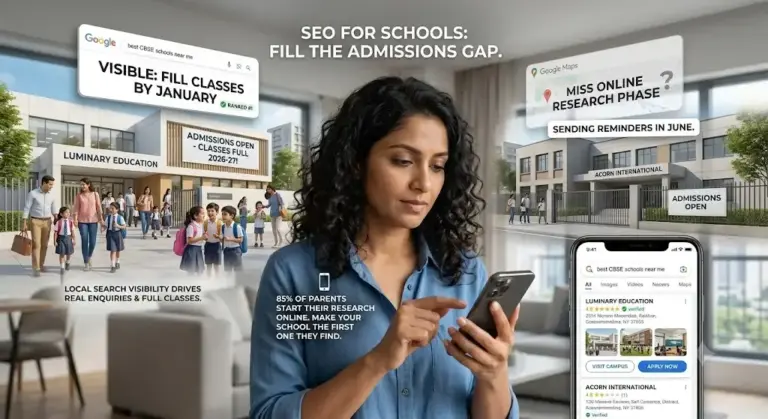


How SEO Drives Admissions for Educational Institutions

⚡ Key Takeaways
- 68% of all online experiences begin with a search engine — and your prospective students are no different
- Most educational institutions lose admission leads not because of poor courses, but because of poor search visibility
- SEO for educational institutions works across three layers: Technical (site health), On-Page (content relevance), and Off-Page (authority building)
- Long-tail keywords like “BBA colleges in Jaipur with low fees” convert dramatically better than broad generic terms
- Local SEO and Google Business Profile optimisation alone can double your enquiry volume from nearby students
- Without measuring organic traffic, keyword rankings, and lead sources, your SEO investment has zero accountability
Your college may offer exceptional programmes, experienced faculty, and a strong placement record — and yet a lesser-known institution down the road is getting three times more online enquiries. How?
Most admission teams genuinely struggle to connect the dots between their website and actual student enquiries. The digital piece feels technical, opaque, and difficult to measure — which is exactly why so many institutions either ignore it completely or hand it to someone who barely understands it.
This post breaks down exactly how SEO for educational institutions works in practice, why it directly impacts your admission numbers, and what specific actions your institution can take right now to start ranking where your future students are already searching.
Why Most Educational Institutions Are Invisible Online
Here’s a difficult reality. Having a website does not mean students can find you.
A website that nobody discovers is the digital equivalent of a beautifully designed brochure locked inside a cupboard. It looks impressive internally. It does absolutely nothing externally.
The Search Behaviour of Today’s Indian Student
A 2023 Google India study confirmed that over 68% of prospective students begin their college research with a search engine query — not a referral, not a campus visit, and not a newspaper advertisement.
Their searches look like this:
- “Best engineering colleges in Hyderabad under 1 lakh fees”
- “Top MBA colleges in India with good placement record”
- “BCA admission 2026 in Delhi with scholarship”
These are high-intent, long-tail searches. The student typing this query is not browsing casually. They are actively evaluating options and ready to submit an enquiry within hours.
If your institution doesn’t appear on page one of Google for these searches, you simply don’t exist in their decision-making process. That’s not an exaggeration — it’s how search behaviour actually works.
Why Paid Ads Alone Won’t Solve This
Many institutions respond to poor visibility by running Google Ads. Ads work — but only while the budget runs. The moment you stop spending, the traffic vanishes completely.
SEO for colleges and universities builds an organic presence that continues generating traffic and admission leads long after the initial investment. It’s not free — it requires time and genuine expertise — but the long-term return significantly outperforms paid-only strategies when measured across a full academic year.
What Education SEO Actually Involves
Education SEO is not about stuffing your homepage with the phrase “best college in India.” That approach stopped working years ago and now actively damages your rankings.
Modern higher education SEO operates across three interconnected layers.
Layer 1: Technical SEO — The Foundation Nobody Sees
Technical SEO ensures that Google can crawl, understand, and index your website properly. If this foundation has cracks, no amount of content or backlinks will rescue your rankings.
Key technical factors for educational institutions:
- Mobile loading speed — Google uses mobile-first indexing. If your site takes more than 3 seconds to load on a phone, you’re losing both rankings and students simultaneously
- HTTPS security — A non-secure website signals distrust to both Google and every prospective student who lands on it
- Core Web Vitals — Google’s page experience metrics (LCP, CLS, FID) directly affect where your pages appear in search results
- Proper URL structure — Clean, descriptive URLs like /mba-programme-mumbai outperform /page?id=4872 on every ranking factor
- XML sitemap and robots.txt — These files tell Google exactly what to crawl and what to prioritise across your entire domain
Most Indian educational institution websites fail on at least two or three of these points. Here’s the part that should make you exhale: fixing them alone can produce meaningful ranking improvements within 60–90 days — without writing a single new piece of content.
Not sure where your institution’s website stands technically? Request a free SEO audit from a specialist who works with Indian colleges and universities — it takes 24 hours and costs nothing.
Layer 2: On-Page SEO — Content That Answers Real Questions
On-page SEO makes sure every page on your website clearly communicates what it’s about — to both Google and the student reading it.
This includes:
- Dedicated programme pages for every course you offer, targeting specific search terms like “BBA admission in Pune 2026”
- H1 and H2 tags that contain the actual phrases students type into Google
- Meta titles and descriptions written to earn clicks, not just appear in results
- Internal linking between related pages — connecting your MBA page to your placement record page, for instance
- Structured content that answers the questions students actually ask: fees, eligibility, duration, placement, faculty.
One of the highest-value on-page opportunities most institutions miss entirely: course-specific FAQ sections. Google frequently pulls these directly into its “People Also Ask” boxes, giving your institution premium above-the-fold visibility without needing the top organic ranking. This is an advanced insight that most generic marketing agencies never know to recommend.
Layer 3: Off-Page SEO — Building Authority Through Trust Signals
Google ranks institutions it trusts. Trust, in Google’s language, is measured largely through backlinks — other reputable websites linking back to yours.
For educational institutions in India, strong off-page SEO involves:
- Getting listed and linked from education directories like Shiksha, Collegedunia, and GetMyUni
- Earning mentions in local news outlets and regional education publications
- Building partnerships with schools that link to your scholarship or admission pages
- Publishing original research or annual placement reports that other sites naturally reference and cite
- Partnering with state skill development initiatives, local municipal bodies, or hosting regional inter-college symposiums to earn .ac.in or .gov.in backlinks — in Google’s trust hierarchy, one verified .gov.in link carries the authority weight of fifty standard commercial links. This is the Indian web ecosystem’s single most underused SEO advantage, and almost no institution is actively pursuing it
A single high-authority backlink from a credible education portal or government academic body does more for your rankings than 50 low-quality directory submissions combined.
Student Recruitment SEO: The Local and Long-Tail Advantage
Here’s where most education SEO advice becomes generic and stops being useful. Let’s get specific.
Why Long-Tail Keywords Drive More Admissions Than Broad Terms
Broad keywords like “MBA college India” carry enormous search volume. They also face brutal competition — IIMs, large private universities with massive budgets, and established education portals dominate those results completely.
You will not beat them in the short term. And honestly, you don’t need to.
Long-tail keywords are where smaller and mid-sized institutions win meaningful, converting traffic. Consider this comparison:
| Keyword | Monthly Searches | Competition | Conversion Likelihood |
|---|---|---|---|
| MBA college India | 90,000+ | Extremely High | Low (Top of funnel) |
| MBA colleges in Coimbatore with fees | 1,200 | Low–Medium | Very High (Ready to enquire) |
| BBA admission 2026 Jaipur scholarship | 480 | Low | Extremely High (Decision stage) |
| Engineering colleges in Nashik NAAC A | 320 | Very Low | Extremely High (Shortlisting stage) |
The student searching “MBA colleges in Coimbatore with fees” is not casually browsing. They are actively comparing. Appear in those results, and you’re on their shortlist. This is exactly how SEO drives admission lead generation for institutions that cannot outspend national players on advertising.
This table is also the argument your marketing team needs when a college trustee asks: “Why aren’t we ranking number one for ‘MBA India’?” Show them the conversion column. Volume without intent is noise.
Local SEO — The Most Underused Admission Tool in India
If your institution serves a specific city or region, local SEO is your single fastest path to more qualified enquiries.
Google Business Profile (GBP) is the non-negotiable starting point. A fully optimised GBP listing — with accurate contact details, high-quality photos, regular admission-season posts, and genuine verified student reviews — can place your institution in the Google Maps “local pack”: those three results that appear at the very top of location-based searches.
Institutions appearing in the local pack receive 44% of total clicks on the search results page (BrightLocal Local Consumer Review Survey, 2023).
Nearly half of everyone searching “engineering college near me” or “BCA college in [your city]” clicks on one of those three listings. Getting into those positions requires consistent local SEO work — not a paid advertising budget.
🎯 Want to appear in Google’s local pack before your next admission season opens? A focused local SEO strategy can show measurable results in 60–90 days. Talk to an education SEO specialist today.
How to Build an SEO Strategy That Increases Student Admissions
Let’s move from theory to actual implementation. Here’s a practical sequence your institution can follow immediately.
Step 1: Conduct Keyword Research Specific to Your Programmes
Don’t guess what students search for. Use Google Search Console, the free Google autocomplete feature, and the “People Also Ask” section to identify the exact phrases prospective students type during their research.
Build a keyword list organised by:
- Programme type (MBA, BCA, B.Tech, B.Ed, Diploma, etc.)
- Location (the specific city, district, or state you draw students from)
- Search intent (informational research vs. ready-to-apply decision stage)
Step 2: Build Dedicated Landing Pages for Every Programme
Your homepage cannot rank for 20 different courses simultaneously. Build individual, optimised pages for each programme you offer.
Each page should target 2–3 specific long-tail keywords and answer the five questions every prospective student asks: What is this course? What are the fees? Who is eligible to apply? What are the career outcomes? How do I apply right now?
Step 3: Start a Content Strategy Built Around Student Questions
A blog or resource section is not optional for higher education SEO — it’s a long-term admission engine that works while your admission team sleeps.
Write content that directly answers questions your future students type into Google:
- “Is BBA worth doing in 2026?”
- “Average salary after MBA from a private college in India”
- “Difference between BCA and B.Sc Computer Science — which is better for 2027 jobs?”
Each article becomes a permanent, indexed page that ranks, attracts high-intent traffic, and builds genuine trust with students who are still in the early research phase of their decision journey.
Step 4: Fix Technical Issues Before Producing New Content
Run a technical audit using Google Search Console (free), Screaming Frog, or SEMrush. Identify and resolve broken links, slow-loading pages, missing meta tags, and duplicate content issues.
“Producing new content on a technically broken website is like pouring water into a cracked bucket. Fix the bucket first.”
Step 5: Track the Right Metrics — Not Just Search Rankings
Rankings matter, but they don’t fill seats on their own. Track these metrics every month without exception:
- Organic traffic to your key programme landing pages
- Enquiry form submissions attributed specifically to organic search visitors
- Google Business Profile views, calls, and direction requests
- Keyword position changes for your primary target terms
- Conversion rate from organic visitor to submitted enquiry form
Connect Google Analytics 4 and Google Search Console to your website if they aren’t already live. And here’s the attribution step most institutions miss completely: ensure your enquiry forms automatically capture the Referrer URL in a hidden field.
When your admissions counsellor calls a prospective student, your CRM should already tell them — “This student found us via the BBA Jaipur Fees landing page” — before the conversation even begins. That level of attribution transforms how your admission team prioritises follow-up calls and directly improves your conversion rate from enquiry to confirmed seat.
Without this data infrastructure, you’re making budget decisions based on assumptions — and assumptions don’t fill seats.
Conclusion
SEO for educational institutions is not a technical luxury reserved for large universities with enormous marketing budgets. It’s a structured, measurable, and repeatable approach to making sure your institution appears precisely when prospective students are actively searching for what you offer.
The institutions winning the admissions battle across India right now are not necessarily the ones with the best programmes or the most prestigious names. They’re the ones that show up consistently on Google, answer student questions before their competitors do, and convert that search traffic into genuine enquiries through well-built landing pages, fast response systems, and proper attribution tracking.
Your future students are searching right now — for your courses, your city, your fee range. The only question is whether your institution is the answer they find.
Start with a professional SEO audit of your institution’s website. Identify exactly where you’re losing prospective students to competitors online — and build a clear plan to fix it before your next admission season opens.
Frequently Asked Questions
What is SEO for educational institutions and how does it directly help with admissions?
SEO for educational institutions means optimising your college or university website to rank higher in Google search results when prospective students search for relevant programmes and courses. Higher rankings generate more organic traffic, more enquiry form submissions, and ultimately more confirmed admissions — without the ongoing cost of paid advertising campaigns eating into your budget year after year.
How long does education SEO take to show measurable results?
Education SEO typically shows meaningful improvements in organic traffic and keyword rankings within 3–6 months of consistent implementation. Technical SEO fixes can produce results faster — sometimes within 60–90 days. Higher education SEO is a long-term investment, but the cumulative traffic and admission leads it generates over a full academic year far outpace the short bursts produced by paid campaigns alone.
What keywords should educational institutions target for student recruitment SEO?
Student recruitment SEO performs best when you target long-tail, location-specific keywords rather than broad national terms. High-converting examples include “MBA colleges in Ahmedabad with fees 2026,” “BCA admission 2027 Delhi scholarship,” or “NAAC A engineering college in Nagpur.” These specific searches come from students already in decision mode — they are dramatically more likely to submit an enquiry than someone searching a generic broad term.
Is local SEO actually important for colleges and universities in India?
Local SEO is one of the most powerful and consistently underused tools for admission lead generation among Indian educational institutions. A fully optimised Google Business Profile, combined with targeted local keyword content, can place your institution in the top three local search results — which collectively receive 44% of all clicks on location-based searches, according to BrightLocal’s 2023 Consumer Review Survey.
How is SEO different from Google Ads for increasing student enrolments?
Google Ads generates immediate traffic but stops completely the moment your budget runs out. SEO for student enrollment builds organic visibility that compounds over time — ranking your pages for years after the initial investment is made. For institutions with consistent annual admission cycles, SEO delivers a significantly lower cost per lead over a 12-month period compared to running paid search campaigns alone.
What is the single most common SEO mistake educational institutions make?
The most common mistake in higher education SEO is relying on one generic homepage to rank for every course, every city, and every audience simultaneously. Effective SEO for colleges and universities requires dedicated, individually optimised landing pages for each programme — each one targeting the specific long-tail keywords that prospective students actually search during the admission research and shortlisting process.
Last updated: October 10, 2026
Frequently Asked Questions
Learn more about GladOwl® & how we work.
Only education. Universities, colleges, B-Schools, EdTech platforms, coaching & skill institutes across India — higher education, & nothing else.
Six pillars: research, technology, branding, marketing, admissions & AI tools — run as one integrated team & measured on enrolments.
Ideally four to six months before applications open. That leaves time for research, creative & landing pages before media spend starts.
Yes. We plan & run Google, Meta & YouTube campaigns, with reporting tied to enquiries, applications & enrolments.
We welcome contributions from admissions leaders & educators. Write to namaste@gladowl.com with a short pitch.
Tell us about your institution on the contact page & we’ll set up a discovery call within two working days.