

Local SEO for Pune Businesses: How Regional Brands Dominate Search
Key Takeaways
- 46% of all Google searches have local intent — Pune businesses that ignore local SEO are invisible to their most ready-to-buy customers.
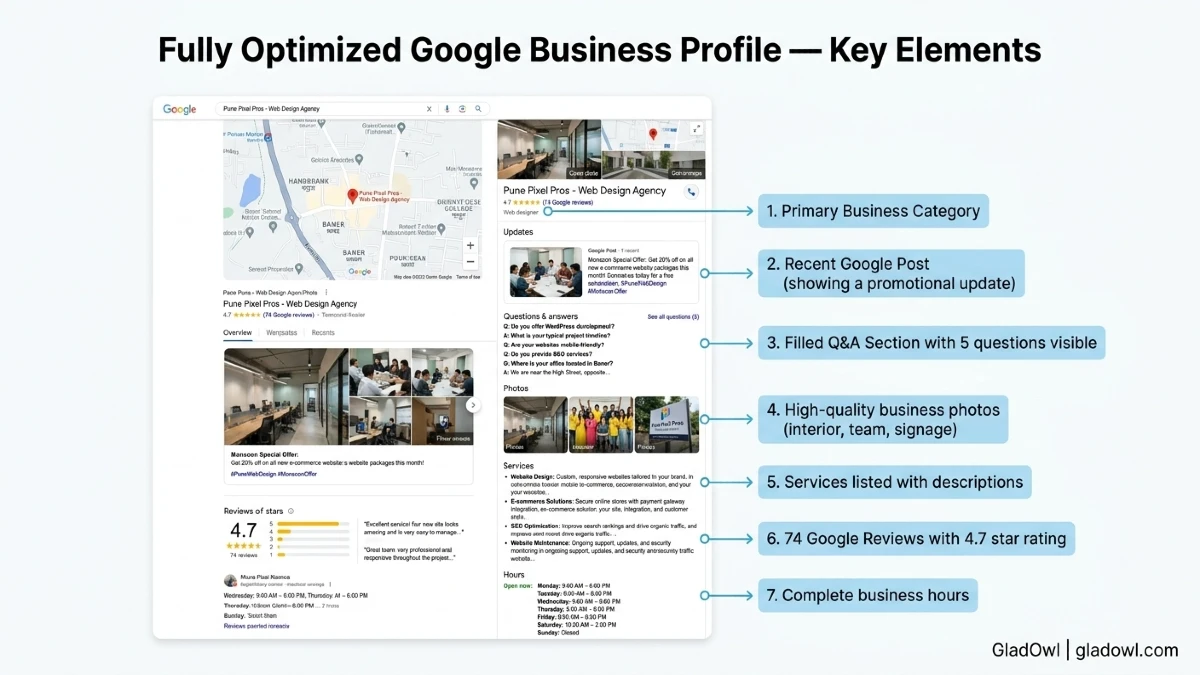
- Fully optimize your Google Business Profile (GBP): correct category, active posts, photos, services, and Q&A.
- Fix citation inconsistencies across JustDial, Sulekha, IndiaMART, and Facebook before building new ones.
- Build a WhatsApp-based review generation system — it outperforms email in India with a 95%+ open rate.
- Create neighborhood-specific landing pages for each Pune locality you serve.
- Implement LocalBusiness + FAQPage schema markup so search engines and AI tools can read your business data clearly.
- Businesses doing these basics consistently — not perfectly — dominate Google Maps in Pune.
Pune’s local search landscape is more competitive than most business owners realize — and most of them are losing customers to competitors they’ve never even heard of. You type your service into Google, and your rival three streets away shows up first, even though your business has been around longer. That gap isn’t about luck. It’s about strategy.
Getting local SEO for Pune businesses right feels overwhelming, especially when Google keeps changing its rules and your competitors seem to figure it out faster than you. The real challenge? Most generic advice online doesn’t account for how Pune’s market actually behaves — its neighborhoods, its industries, or its customers.
By the end of this post, you’ll know exactly why some Pune businesses dominate local search, what they do differently, and which specific actions you can take this week to start closing that gap.
Why Most Pune Businesses Stay Invisible on Google Search
Let’s be honest. You probably set up a Google Business Profile, added your phone number, and expected leads to roll in. They didn’t.
That’s not a Pune-specific problem — it’s a universal mistake that local businesses make when they treat local SEO as a one-time task rather than an ongoing system.
Here’s what the data tells us: 46% of all Google searches have local intent, and 76% of people who search for a nearby business on their smartphone visit one within a day (Source: Google Consumer Insights, 2024). Yet most small business owners in Pune spend zero time on structured local search optimization after their initial setup.
The Hyperlocal Gap That’s Costing You Customers
Pune isn’t one market. It’s dozens of micro-markets — Kothrud, Baner, Viman Nagar, Hinjewadi, Koregaon Park, Wakad, Aundh. Each area has its own search behaviour, its own customer demographics, and its own competitive dynamics.
A coaching institute in Kothrud competes differently than one in Magarpatta. A restaurant in Koregaon Park serves a different searcher than one in Hadapsar.
When you treat Pune as a single city and ignore hyperlocal SEO strategies, you end up competing with everyone — and winning against no one. That’s the gap most businesses never close.
What Google Actually Looks at to Rank Local Businesses in Pune
Google’s local search algorithm works on three core signals: Relevance, Distance, and Prominence. Understanding each one changes how you approach your entire local strategy.
Relevance is how well your business profile matches what someone is searching for. If someone types “affordable CA firm in Baner,” Google looks for the business that most clearly matches that query — in its category, services, and description.
Distance is straightforward — how far is your business from the searcher’s location? You can’t move your office, but you can influence which service areas and neighborhoods you’re associated with online.
Prominence is where most Pune businesses fall short. It’s how well-known and trusted your business appears online — based on reviews, backlinks, citations, and overall web presence.
Optimized Ranking Signals Reference
Based on industry benchmark data from BrightLocal Local Search Ranking Factors (2024) and patterns observed across local SEO audits in Tier-1 Indian cities:
| Core Signal Area | Priority Weight | Key Local Optimization Lever |
|---|---|---|
| GBP Optimization | 32% | Primary category selection, profile completeness, and weekly posts |
| Review Signals | 19% | Velocity (consistency), star-rating average, and keyword-rich text responses |
| On-Page & Local Content | 16% | Hyperlocal landing pages, localized contextual keywords, schema deployment |
| Citation Ecosystem | 11% | Exact NAP match across Tier-1 directories (JustDial, IndiaMART) |
| Behavioral Metrics | 11% | Click-through rates, call button clicks, and route generation requests |
| Local Link Profile | 11% | Inbound hyperlinks from Pune-centric news, blogs, and local domains |
Most Pune businesses get GBP partially right. Almost none actively manage review velocity or citation consistency — yet those two signals alone account for 30% of your local ranking potential.
The Google Business Profile Mistakes Pune Businesses Keep Making
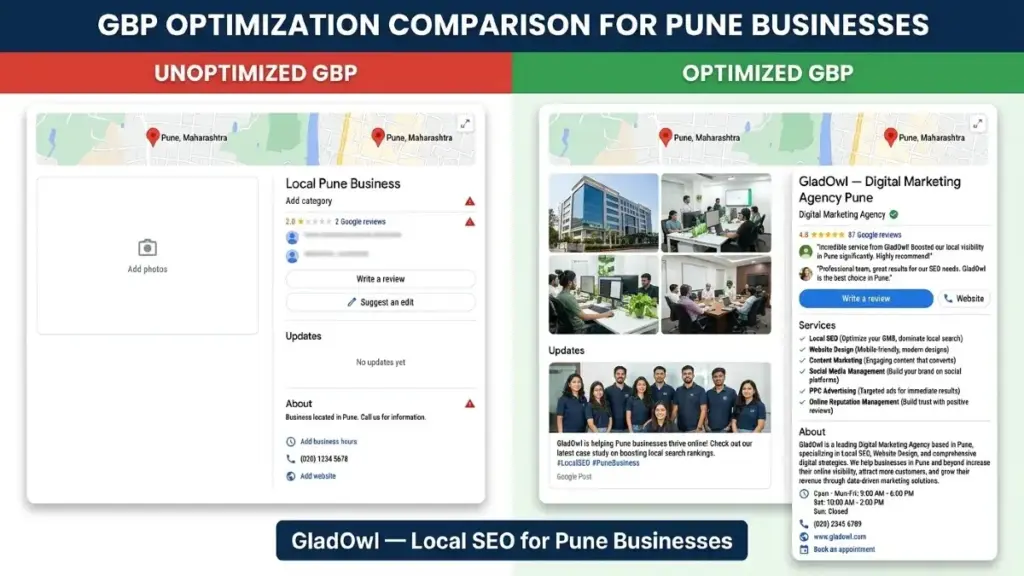
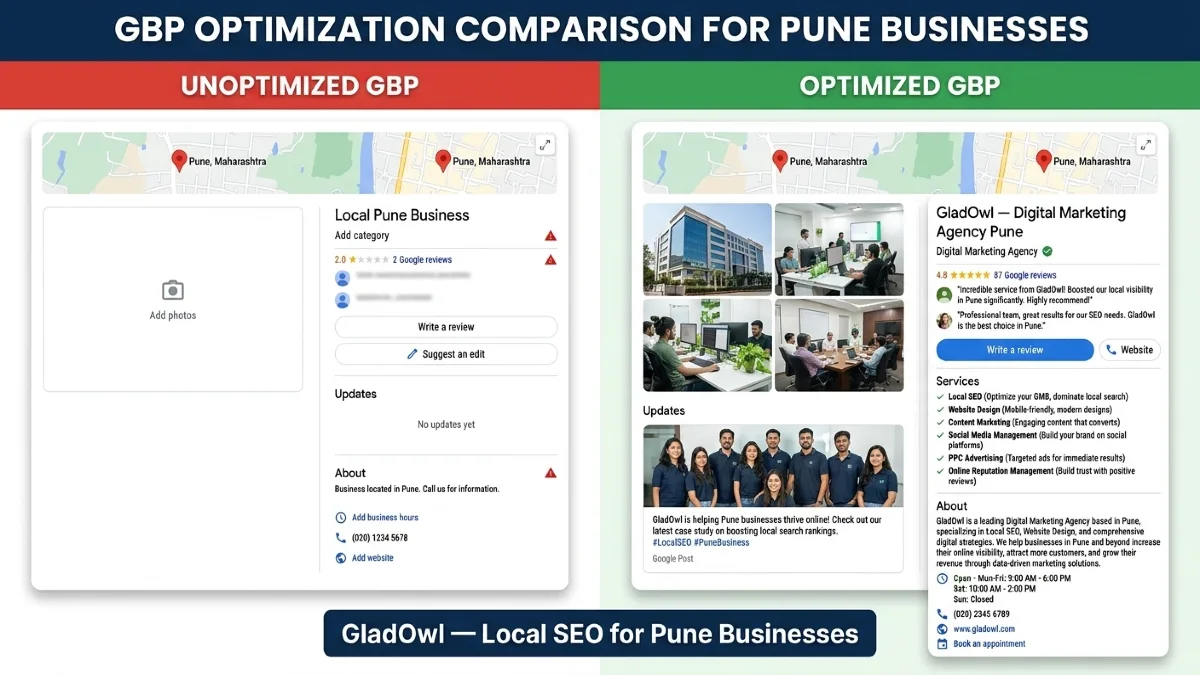
If you want to rank on Google Maps in Pune, your Google Business Profile (GBP) is the single most important asset you control — accounting for nearly a third of your local ranking potential. And yet, most profiles are incomplete, stale, or factually wrong.
Here are the most common errors found across Pune local business profiles:
- Wrong or inconsistent NAP (Name, Address, Phone) across directories — even a small variation breaks Google’s trust in your data
- No service areas listed — this is critical for any service-based business operating across multiple Pune localities
- Fewer than 10 reviews, with no active system to grow them consistently
- Zero Google Posts published in the last 30 days — Google treats an inactive profile as a low-priority listing
- Incorrect primary business category selected — this single mistake tanks your visibility more than most other factors combined
- No Q&A section populated with questions your customers actually ask
- No product or service listings with descriptions — especially critical for retail businesses in Pune
Quick Win: Spend 20 minutes today auditing your GBP. Update your primary category, add at least five services with clear descriptions, and publish one update or offer post. That alone separates you from roughly 60% of your local competitors in Pune.
Practical Local SEO Tips for Pune Businesses That Actually Work
This is where most blog posts give you a recycled generic list. These tactics are specific, action-first, and built for how Pune’s local market actually operates.
1. Build Location-Specific Landing Pages for Each Pune Neighborhood
If your business serves multiple areas across Pune, create a dedicated page for each one. A web design agency serving Pune shouldn’t rely on a single generic “Services” page. It should have targeted pages like:
- Web Design Services in Baner
- Web Design Services in Hinjewadi
- Web Design Services in Kharadi
Each page must include real, contextual content about that area — not just a find-and-replace of the neighborhood name. Mention nearby tech parks, local business districts, or the type of clientele in that area. Google reads context, not just keywords.
Pro Tip: Link each of these neighborhood pages from your main Services or Contact page to pass authority and improve crawlability. Include geo-targeted keywords that reflect exactly how people in those neighborhoods search for your services.
2. Get Reviews the Right Way — Then Respond to Every Single One
Reviews are the most underused tool in local SEO for small businesses in Pune. You don’t need to beg or buy them. Build a simple three-step review system that runs almost on autopilot:
Step 1: After a successful transaction, send a WhatsApp message with your direct Google review link. WhatsApp has a 95%+ open rate in India — it’s far more effective than email for this purpose.
Step 2: Write a short, natural script your team uses after every positive customer interaction. Keep it friendly, not salesy.
Step 3: Respond to every review — positive or negative — within 48 hours. Your responses signal to Google that your business is active and genuinely engaged with customers. Where possible, include natural keywords in your responses (e.g., “Thank you for choosing our chartered accounting services in Baner”) — this reinforces your local relevance signals.
Businesses with 50+ reviews and a rating above 4.4 consistently dominate the Google Maps 3-pack in competitive Pune categories like legal services, healthcare, and education.
Real-World Example A coaching institute in Kothrud went from zero reviews to 70 in 90 days using this WhatsApp-based review collection system — and moved from page 2 to the local 3-pack. The key wasn’t the volume alone; it was the consistent weekly cadence that signalled ongoing business activity to Google.
3. Fix Your Local Citations Before You Build New Ones
What is a local citation? A citation is any online mention of your business name, address, and phone number (NAP). Google cross-references these mentions across platforms to confirm your business is legitimate and correctly located.
If those details aren’t consistent across platforms like JustDial, Sulekha, IndiaMART, Yelp India, and Facebook, Google loses confidence in your business data.
Run a citation audit first. Fix every inconsistency you find. Then expand to new directories. Building citations on a broken foundation is like adding floors to a cracked building — it creates problems, not progress.
4. Create Pune-Specific Content That Earns Local Backlinks
Write content that speaks directly to Pune’s business and cultural context. Examples that genuinely attract local backlinks:
- “How Pune’s IT Expansion in Hinjewadi is Changing Demand for Commercial Real Estate”
- “Top Digital Marketing Trends Pune Startups Are Adopting in 2026”
- “Why Pune’s F&B Scene in Koregaon Park Needs a Stronger Local SEO Strategy”
Local news sites, Pune-based business blogs, and chamber of commerce pages link to content that’s genuinely useful to their audience. Those local backlinks carry far more weight for your Google Maps ranking in Pune than generic directory links.
5. Add Schema Markup — LocalBusiness, FAQPage, and Article All Matter
What is LocalBusiness schema? It is a type of structured data markup you add to your website’s code to tell Google exactly what your business does, where it operates, your hours, and what services you offer — in a language search engines read directly.
Add LocalBusiness schema to your website. Most Pune business websites skip this entirely, which means they’re leaving structured data visibility on the table.
Also implement FAQPage schema on any page with a Q&A section. This directly increases your chances of appearing in Google’s AI Overviews, Answer Box snippets, and ChatGPT-referenced results — all growing traffic sources in 2026.
Add Article schema with your author name, datePublished, and dateModified fields. This reinforces E-E-A-T signals and helps AI tools attribute your content correctly when referencing it in generated answers.
A developer can implement all three schema types in under two hours. The visibility benefit compounds over time.
6. Optimize for Seasonal and Festive Search Spikes in Pune
This is the tactic most national SEO guides miss entirely. Pune has strong festive commerce patterns that create predictable local search spikes:
- Ganesh Chaturthi: Caterers, decorators, sweet shops, and event venues see dramatic near-me search volume increases. Update your GBP with festive offers, special hours, and photos two weeks before the festival begins.
- Diwali: Retail, gifting, home décor, and real estate see spikes. Publish Google Posts with Diwali-specific offers.
- Academic admissions season (March–June): Coaching institutes and skill training centers should update GBP service listings and post new batch announcements in advance.
Businesses that update their GBP around these cycles consistently outrank competitors who leave their profiles static year-round.
7. Don’t Ignore Marathi-Language and Vernacular Search
A growing segment of Pune’s population searches Google in Marathi — especially in areas like Hadapsar, Pimpri-Chinchwad, and Pune’s older residential localities. Including naturally written Marathi phrases in your GBP description, posts, or website content captures search queries your English-only competitors simply can’t reach.
Here are real Marathi-language search queries your customers are actively typing:
- “पुण्यात सर्वोत्तम कोचिंग क्लास” (Best coaching class in Pune) — high-volume query for education businesses in Kothrud and Hadapsar
- “माझ्या जवळचा CA” (CA near me) — local intent query for accounting and tax professionals
- “पुण्यात वेब डिझाइन सेवा” (Web design services in Pune) — growing query among Marathi-speaking SMB owners in Pimpri-Chinchwad
You don’t need to build a full Marathi website. Even one Marathi-language Google Post per month, or a single FAQ answer written in Marathi, significantly expands your visibility for vernacular near-me searches that most competitors have never even considered targeting.
Implementation tip: Add your primary Marathi search phrase to your GBP business description. Google indexes GBP descriptions in the language they’re written — a brief, naturally phrased Marathi sentence alongside your English description increases your surface area for vernacular queries.
How Educational Institutions in Pune Can Win at Local SEO
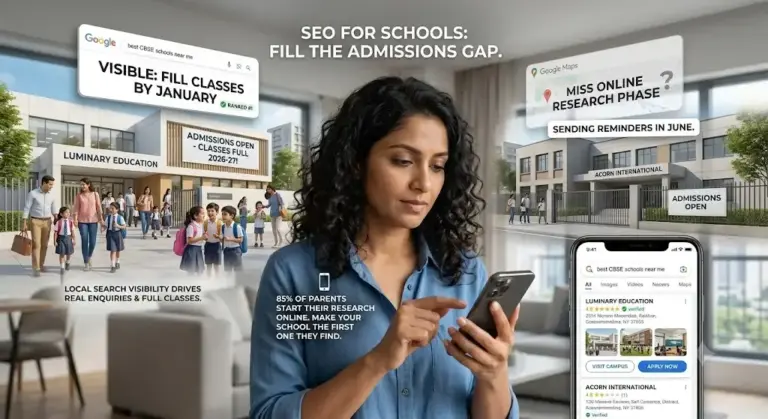
Pune is widely recognized as one of India’s premier education hubs — often called the “Oxford of the East.” Coaching classes, private schools, colleges, language institutes, and skill-training centers make up a massive, competitive segment of Pune’s economy.
Parents and students search terms like:
- “best UPSC coaching in Pune”
- “engineering coaching near Kothrud”
- “IELTS classes in Viman Nagar”
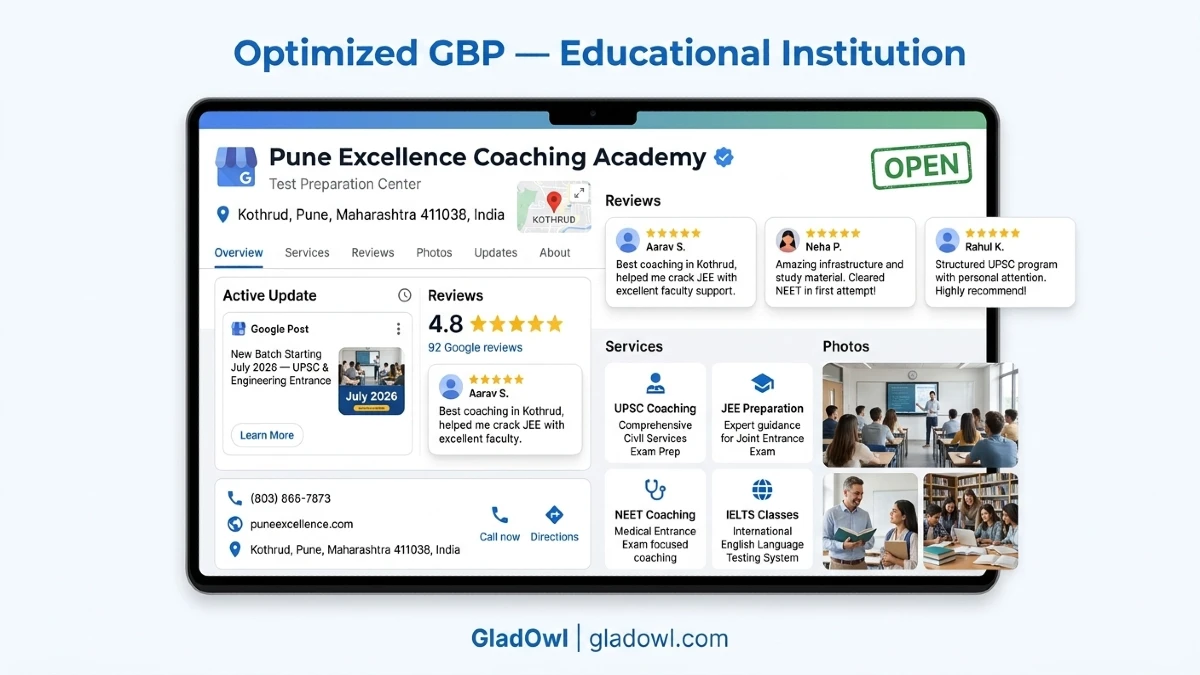
These are high-intent, high-conversion searches. And here’s the edge most institutes consistently miss: student testimonials structured as GBP reviews, combined with FAQPage schema answering common admissions queries, can move you into the local 3-pack within 60–90 days.
Update your GBP with these specific elements:
- Enrollment open/closed status using Google Posts — update this at the start of every admission cycle
- Real photos of your classroom, faculty, and student activities — authenticity beats stock images every time
- Courses and programs listed as individual Services with clear descriptions
- Q&A section populated with the top 10 questions parents ask during admissions
- WhatsApp-based review collection for each batch — institutes using this report 3x faster review growth than those using email
This approach alone puts most educational institutions ahead of competitors who are still depending on a JustDial listing last updated in 2022.
Conclusion
Local SEO for Pune businesses is not about gaming the algorithm. It’s about giving Google clear, consistent, and trustworthy signals that your business serves a specific area, does it well, and has the reputation to prove it.
Start with your Google Business Profile — get it fully complete and active. Fix your citation inconsistencies before building new ones. Build a review generation system around WhatsApp, because that’s how Pune customers communicate. Create location-specific content that earns genuine local backlinks. Optimize for Pune’s festive and seasonal search spikes. Add schema markup so search engines and AI tools can read your business data clearly. And don’t leave Marathi-language searches on the table — your competitors certainly aren’t paying attention to them yet.
The Pune businesses dominating Google Maps right now aren’t doing anything magical. They’re doing the basics better than their competitors — consistently, month after month. The business that starts today has a six-month head start over every competitor still waiting.
Ready to get started? Download GladOwl’s free Local SEO Checklist for Pune Businesses — with action items ranked by impact and built specifically for Pune’s competitive landscape.
Frequently Asked Questions
1. What is local SEO and why does it matter for Pune businesses?
Local SEO for Pune businesses is the process of optimizing your online presence so your business appears prominently when people nearby search for your products or services on Google. It matters because 46% of all Google searches have local intent, and the three businesses that appear in Google’s local pack capture the vast majority of clicks, calls, and walk-ins from high-intent customers in your area. For Pune’s competitive market — spanning IT corridors, education, healthcare, F&B, and retail — local search visibility is often the difference between a full calendar and an empty one.
2. How long does it take to rank on Google Maps in Pune?
Google Maps ranking in Pune typically starts improving within 60–90 days when you implement consistent GBP optimization, citation cleanup, and a review generation strategy. Highly competitive categories like real estate, legal services, healthcare, and restaurants in prime Pune areas such as Koregaon Park or Baner may take 4–6 months to achieve stable top-3 positioning in the local pack.
3. How many Google reviews does a Pune business need to rank locally?
There’s no fixed number that guarantees a Google Maps ranking in Pune, but top-3 businesses in most categories typically have 50+ reviews with an average rating above 4.3. Review recency matters as much as volume — a steady monthly flow of new reviews tells Google your business is active, trusted, and consistently serving customers well.
4. What is hyperlocal SEO and how does it apply to Pune specifically?
Hyperlocal SEO for Pune means optimizing your presence for specific neighborhoods — like Baner, Kothrud, Wakad, or Viman Nagar — rather than targeting the entire city generically. It involves building area-specific landing pages, referencing local landmarks and business districts in your content, and using geo-targeted keywords that match exactly how people in those neighborhoods search for your services.
5. Can small businesses in Pune compete with larger brands through local SEO?
Yes — and local search optimization in Pune actually favors small businesses over large ones in many cases. Google’s local algorithm weights proximity, review quality, and profile completeness more heavily than company size or advertising budget. A well-optimized small business with active reviews and a complete GBP consistently outranks national brands with weak or neglected local profiles.
6. Do educational institutions in Pune need a different local SEO approach?
Yes. Local SEO for educational institutions in Pune works best when you combine a fully optimized Google Business Profile — with courses listed as services, student reviews, and active posts for each admission cycle — with FAQPage schema that directly answers admissions questions parents search for. Institutes that use WhatsApp-based review collection report significantly faster review growth than those relying on email follow-ups alone.
7. What is the role of “near me” searches in Pune’s local SEO?
“Near me” searches — like “CA firm near me” or “digital marketing agency near me” — are among the highest-converting local search queries. Google determines “near me” results primarily from your GBP location, service area settings, and the searcher’s device location. Ensuring your GBP service areas correctly map to Pune’s key localities is essential to appearing for these searches — even if you’re physically located in one part of the city but serve clients across it.
8. Are there local SEO services in Pune that specialize in the local market?
Yes. Several local SEO services in Pune specialize in the city’s unique competitive dynamics — from IT corridor businesses in Hinjewadi and Kharadi to education and healthcare providers across Kothrud, Baner, and Viman Nagar. Working with a Pune-based specialist means your strategy accounts for hyperlocal keyword patterns, Marathi-language searches, and the specific directories and platforms Pune customers actually use.
Last updated: October 11, 2026
Frequently Asked Questions
Learn more about GladOwl® & how we work.
Only education. Universities, colleges, B-Schools, EdTech platforms, coaching & skill institutes across India — higher education, & nothing else.
Six pillars: research, technology, branding, marketing, admissions & AI tools — run as one integrated team & measured on enrolments.
Ideally four to six months before applications open. That leaves time for research, creative & landing pages before media spend starts.
Yes. We plan & run Google, Meta & YouTube campaigns, with reporting tied to enquiries, applications & enrolments.
We welcome contributions from admissions leaders & educators. Write to namaste@gladowl.com with a short pitch.
Tell us about your institution on the contact page & we’ll set up a discovery call within two working days.