
A student in Mumbai opens ChatGPT and types: “Which private engineering college in Pune has the best placement record under 1.5 lakh fees?” Your college might have exactly that. But if AI search for colleges does not surface your institution in that answer, you simply do not exist for that student.
That is the new reality. And most Indian colleges have no idea it is already happening.
The challenge is that AI search works differently from traditional Google search. The rules have shifted — and they shifted quietly. By the end of this post, you will understand exactly how AI search affects your college website, what AI Overviews and Answer Engine Optimization mean for higher education, and what you can do about it right now.
Why Traditional SEO Is No Longer Enough for Colleges
For years, the formula was straightforward. Rank on page one, get clicks, get enquiries.
That formula is breaking.
Google’s AI Overviews now answer student queries directly inside the search results page. ChatGPT, Perplexity, and Google Gemini pull institutional information from across the web and present a synthesized answer — often without the student ever visiting your website.
The Invisible College Problem
Here is what this means in practice. A student searches “best BCA colleges in Bangalore with hostel facility.” Google’s AI Overview surfaces three colleges by name, pulls a fee range, and lists admission criteria — all without a single click to any college website.
If your college is not structured in a way that AI systems can read, extract, and trust — you are invisible. Not on page two. Invisible.
A 2024 study by BrightEdge found that AI Overviews appear in over 42% of search queries. For informational queries — which most student searches are — that number is even higher.
According to data from the NIRF portal, over 6,000 higher education institutions are listed in India. The ones capturing AI-driven student attention represent a fraction of that number — and that fraction is growing its enquiry volume while others stagnate.
How AI Search Actually Works — and Why College Websites Struggle
AI search systems do not browse websites the way humans do. They look for clear, structured, entity-rich information they can extract with confidence.
Think of it this way. If your “Admissions” page is one long paragraph with no headers, no specific fee numbers, no eligibility criteria broken into readable points — an AI system skips it. It cannot extract a clean answer. So it uses a competitor’s page that is better structured.
What AI Systems Look for on a College Website
- Direct answers to specific questions — fee structures, intake capacity, eligibility, scholarship details
- Structured data markup — Schema.org tags for educational organizations, courses, FAQs, and events
- Entity clarity — Is it obvious to a machine what your college is, where it is, what it offers, and who it is affiliated with?
- Consistent information across the web — Your NAAC grade on your website should match what appears on NIRF, your Google Business Profile, and education directories like Shiksha, Careers360, MyStateSchool, and CollegeDekho
- Authoritative external mentions — Citations from news sites, government portals, and respected directories signal trustworthiness to AI systems
Most college websites in India fail on at least three of these five points. A content audit of private college websites across Pune, Hyderabad, and Lucknow shows the majority still use unstructured admission pages, have no FAQ schema, and show inconsistent NAAC or affiliation details across platforms.
Is your college website structured for AI search visibility? A technical SEO audit can tell you exactly where you are losing students before they ever visit your campus. Start with your admission and course pages first.
AI-Invisible vs. AI-Ready: A Direct Comparison
The gap between an AI-invisible and an AI-ready college website is not about design. It is about structure, data, and information clarity.
| Feature | AI-Invisible College Website | AI-Ready College Website |
|---|---|---|
| Admission details | Buried inside PDF downloads | Structured HTML page with clear headings |
| FAQ section | None | Present with FAQ schema markup |
| NAAC / affiliation | Missing or inconsistent | Consistent across website, NIRF, and aggregators |
| Course listings | Generic overview pages | Dedicated pages per course with fees, duration, eligibility |
| Schema markup | Zero structured data | EducationalOrganization + Course + FAQ schema implemented |
| External presence | Absent from major directories | Listed and consistent on Shiksha, MyStateSchool, Careers360, CollegeDekho |
| Google Business Profile | Unverified or outdated | Active, verified, reviewed regularly |
The AI-ready website does not just rank better on Google. It gets cited by AI systems. It appears in Perplexity answers. It shows up in ChatGPT responses when a student asks for college recommendations.
What a Real Result Looks Like
That is what a higher education GEO strategy looks like in practice.
Want to see where your college stands on AI search visibility? Check your college’s structured data readiness using Google’s Rich Results Test tool — it takes under five minutes and shows exactly what AI engines can and cannot read on your pages.
How Colleges Can Prepare for AI Search: A 5-Step Checklist
You do not need to rebuild your website from scratch. You need to make targeted, strategic changes.
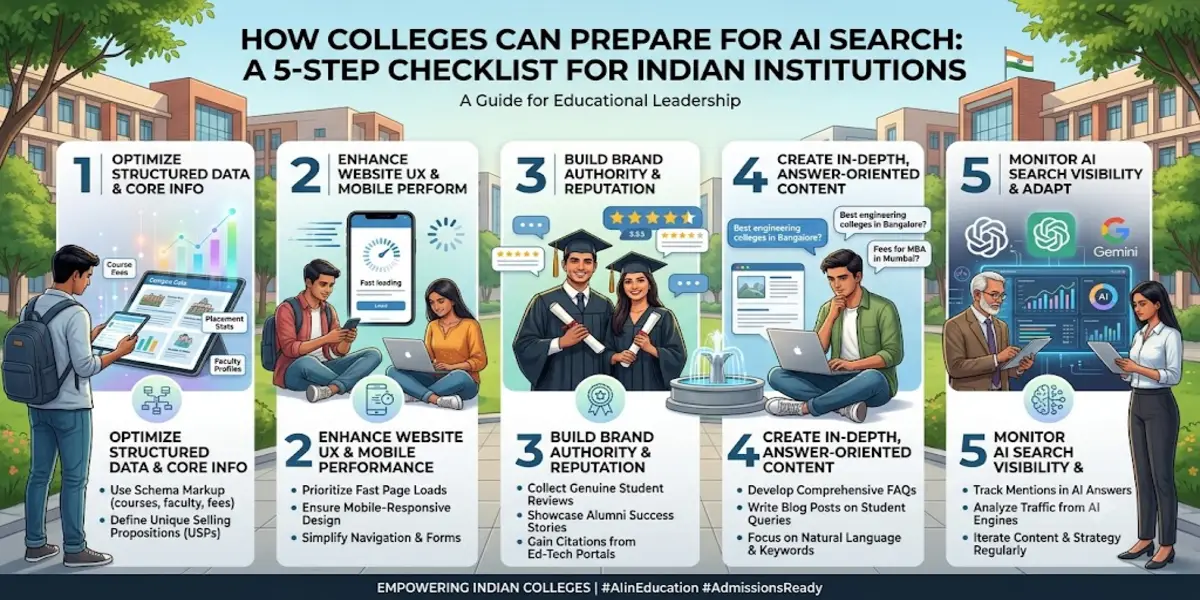
Step 1: Audit Your Existing Content for AI Readability
Go through your top 10 most visited pages. Ask: can a machine extract a clean, direct answer from this page in under 5 seconds?
If the answer is no — rewrite that page. Use short paragraphs. Add headers. Break fees and eligibility into bullet points or tables.
Refer to Google’s Search Essentials guide to understand what makes a page machine-readable by default.
Step 2: Add FAQ Schema to Key Pages
Every admission page, every course page, and your homepage should have an FAQ section — written the way students actually ask questions.
Not: “What is the admission procedure?”
But: “How do I apply to your BBA programme for the 2025–26 batch?”
Mark that FAQ up with schema.org/FAQPage structured data. This directly feeds Google’s People Also Ask section and increases the chance of appearing in AI Overviews.
Step 3: Implement EducationalOrganization Schema
This tells Google, Bing, and AI systems exactly what your institution is — name, address, affiliation, accreditation, courses offered, and contact details.
Refer to the official Schema.org EducationalOrganization documentation for the correct markup format. A developer can implement this in roughly two hours. The impact on AI search visibility for universities can last for years.
Step 4: Build Topical Authority Around Your Programmes
Write genuinely useful content around the questions students are asking — not just about your college, but about the subject area itself.
If you offer B.Tech in Computer Science, publish content about placement trends in software roles, which entrance exams matter, and the difference between CSE and CSE with AI specialization. This builds topical depth that AI systems reward. Pair this with a structured higher education content strategy to stay consistent across admission cycles.
Step 5: Fix Information Consistency Across the Web
Check every external source that mentions your college — your NIRF listing, your affiliating university’s website, Shiksha, Careers360, CollegeDekho, MyStateSchool and your Google Business Profile.
Every inconsistency in your NAAC grade, fee details, or contact information creates doubt in AI systems. Consistent, matching information across sources builds what SEO practitioners call entity trust — and entity trust is what makes AI engines confident enough to cite you.
Conclusion
AI search for colleges is not a future concern. It is happening right now, and institutions that wait another admission cycle to act will find the gap harder to close.
Your college does not need a bigger marketing budget. It needs a smarter content structure, consistent information across the web, and pages that answer the questions students are actually asking. The colleges showing up in AI Overviews and ChatGPT answers are not necessarily the best colleges. They are the most AI-readable ones.
Talk to a digital marketing team that understands higher education SEO and AI search optimization — and start with a website content audit before the next admission season opens.
Frequently Asked Questions
What is AI search for colleges and why does it matter?
AI search for colleges refers to how tools like Google AI Overviews, ChatGPT, and Perplexity retrieve and present college information when students ask questions. It matters because students increasingly get answers directly from AI without clicking any website — making AI search visibility for universities a direct factor in how many enquiries your admissions team receives.
How does AI search affect college websites differently from traditional SEO?
Traditional SEO focused on ranking your page so users click through. AI search for colleges skips the click entirely — AI systems extract information directly from your pages and present it as an answer. Unstructured content, missing schema, and inconsistent data across platforms make your college website invisible to these systems, regardless of how good your programme actually is.
What is Generative Engine Optimization (GEO) for higher education?
Generative Engine Optimization (GEO) is the practice of structuring your website content so AI-driven search engines can accurately extract, understand, and cite your institution. For higher education in India, this means clear course pages, FAQ schema, EducationalOrganization markup, and consistent information across NIRF, state university portals, and major aggregators like Careers360 and Shiksha.
How can a college prepare for AI Overviews in Google Search?
To prepare for AI Overviews, colleges should add FAQ schema to admission and course pages, implement EducationalOrganization structured data, write content that directly answers specific student questions, and ensure NAAC grade and affiliation details are consistent across the web. These steps form the foundation of effective AI search optimization for higher education institutions.
Does Answer Engine Optimization (AEO) apply to Indian colleges?
Yes, directly. Indian students increasingly use voice search, ChatGPT, and Google’s AI features when researching colleges. Structuring your content to answer specific questions — fees, eligibility, hostel availability, placement rates — in a direct, extractable format is the core of AEO for college websites. The colleges that do this well show up in answers. The ones that do not, simply do not appear.
How long does it take to see results from college website optimization for AI search?
Structural changes like adding schema markup and restructuring admission pages can show measurable results in 4 to 8 weeks. A regional university that implemented FAQ schema and EducationalOrganization markup saw a 28% increase in organic brand queries within 60 days. Building deeper topical authority through content takes 3 to 6 months — which is why starting before the next admission cycle opens matters.
